Currents
Copernicus Marine global analysis and forecast, 1/12°, hourly. Analysis to 3 August, forecast after that.
AKROS · Indian Ocean
The rowing boat AKROS drifted across the Indian Ocean with nobody aboard for sixteen months. We worked out where it was being carried, and took part in the search alongside the expedition vessel, the fishermen and the Réunion coastal service. On 7 August 2026 the boat was returned to Fedor Konyukhov's team.
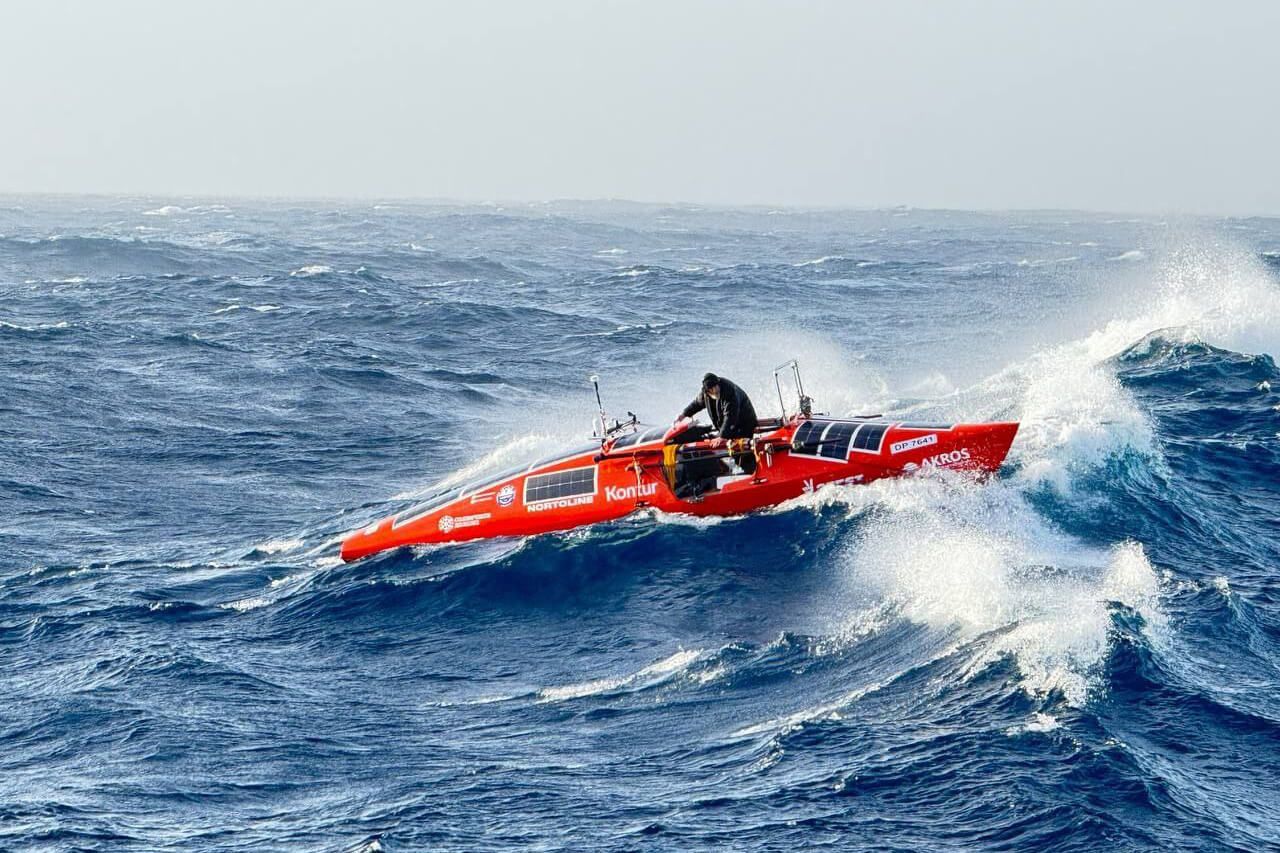
Konyukhov left Cape Horn on the second leg of a rowing circumnavigation, heading for Cape Leeuwin in south-west Australia.
The autopilot control unit failed, then the systems that kept the boat habitable. A Chinese cargo ship took Konyukhov off. The boat stayed in the ocean.
Nothing was known about the boat for thirteen months. The bulk carrier NORDIC NULUUJAAK, master Stepan Butkus of Murmansk, came across it at 27°42′S 061°27′E. The crew took photographs and video and logged the position.
In a year the boat had moved north, at almost the same longitude.
A second position, 21°16′S 053°47′E, between Madagascar and Réunion: the boat was seen from a passing vessel.
A to B is 1,050 km in 78 days, which is 0.16 m/s to the north-west.
Konyukhov's shore team and the project's partners chartered the 60-foot expedition vessel Ocean Tribe in Mauritius. Sailors, local fishermen and the Réunion coastal services joined the search. Our part of the work was the drift calculation: the areas worth searching on a given date.
A fisherman from Réunion found the boat. He could not take it in tow — too big and too heavy — and a coastguard rescue launch was sent out to help.
On the morning of the 7th AKROS was handed over to the project team at 20°58.5′S 055°08.6′E. Fedor Konyukhov went through the boat aboard: the bow compartment dry, the stern compartments flooded. From there it was towed to Mauritius.
Three forces carry a boat with nobody aboard: the surface current, the wind pressing on the part of the hull above the water, and the waves. Search and rescue work calls the wind part leeway and states it as a percentage of wind speed. For a hard-shell survival craft with a drogue out it is about 1 %, without one about 3.5 %. In a 10 m/s wind that is 25 km a day, and over three months several hundred kilometres. Whether AKROS had a drogue out, nobody knew.
Copernicus Marine global analysis and forecast, 1/12°, hourly. Analysis to 3 August, forecast after that.
GFS, 0.25°, at 10 m. Past 3 August it is one deterministic forecast, with no ensemble.
Copernicus Marine, entering the calculation as Stokes drift.
OpenDrift, the Leeway model with the Allen and Plourde coefficient tables. Rescue services use the same ones.
The Leeway catalogue holds seven entries built like AKROS: a hard, enclosed, self-righting shell. We ran all seven — 2,000 particles each from the May position, every particle with its own coefficients drawn from the published spread, and noise on the current and the wind. Over 78 days of free drift it became clear whose cloud passed closest to the July position, and those entries went into the main run.
From the July position we released 20,000 particles and ran them to 12 August. On 4 August the densest cell is at 22.2°S 53.5°E, with the boat carried west-north-west toward the southern tip of Madagascar. This is the map a search party gets: not a point, but the areas that hold the boat with a stated probability.
The 50 % area is where a search starts, and it grew fourfold in eight days, which is why the run was repeated on fresh current and wind fields. The current forecast ran out around 12 August, and past that there was no point calculating.
The boat will not go to sea again: the storms wrecked its equipment, and Oleg Konyukhov, who runs the expedition's shore team, said back in spring 2025 that the only place left for it is a museum. Across two expeditions with Fedor Konyukhov AKROS spent 269 days at sea — 154 in the Pacific in 2019 and 115 in the Southern Ocean in 2025 — and then drifted sixteen months more with nobody aboard.
The project team thanks the crew of the expedition vessel Ocean Tribe, the Réunion coastal service, the local fishermen and everyone who took part in the search.
An unmanned drift with a known ending is rare data: sixteen months from the evacuation point to Réunion. We will keep the model against it, so that next time the search area comes out smaller.